UAlg Hippocampus - The seahorses and the seagrass areas of the Ria Formosa
Download a map (pdf) of the route here
The contribution of the University of Algarve to the knowledge of the threatened marine biodiversity at a global level has been very important and an example is the research on the seahorse (Hippocampus) – a threatened iconic species.
At UAlg we also research the habitat where seahorses live – the seagrass areas of Ria Formosa - a most important blue infrastructure for the absorption of CO2, and contribution to carbon neutrality in the scope of the European Green Deal. In our institution we study the interconnection on both the marine and terrestrial environments in the surrounding area of Ria Formosa, a coastal lagoon, and we also monitor the impacts on this fragile ecosystem namely pollution, microplastics for example.
The itinerary for seahorse preservation aims to be a meeting point for students, staff, locals and tourists combining physical activity and outdoor activities and the observation of the beauty and sustainable in two works by Bordalo II, belonging to an array of around 200 pieces called “Big Trash Animal Collection” built several meters in height, through the 4 continents. One of these pieces of art is located in Praia de Faro (plastic style) built with plastic waste collected in a cleaning action promoted by UAlg V+ (Volunteering Group from the University) and partners, with the support of Faro Municipality and the other piece of art, at the starting point of the itinerary in Campus de Gambelas (neutral style) built with the same material however disguised with painting in a way to resemble the natural colour of the species.
Following the itinerary between these pieces of art we can also understand the biological life cycle of the seahorse depending on the Ria and on the seagrass as well as understand the threats in the surrounding areas and realize how we can all contribute to enjoy a healthier planet.
The itinerary UAlg Hippocampus was funded by the projects Hipposave (Mar2020) and Alimar (Fundo Azul) and the main goals are the knowledge, protection and conservation of the species as well as the awareness of the public for the problems and impact of sea waste. More recently the project Sustainable Horizons (European Union – Horizon Europe - http://bluecampus.irradiare.eu/) strives for a reinforcement of the connection of science with society by using this itinerary as an example of the link between scientists, undergraduate students and citizens in order to comply with United Nations SDG 2030, in Education Quality.
The 8 km itinerary is an interdisciplinary project combining the areas of Marine Biology, Sports, Environment, Health, Chemistry, Arts and the real contributions from citizens who collected part of the marine litter used to produce the pieces of art. It includes 5 panels with QR code with scientific information allowing a deep reflection about this threatened species, its habit and its enormous sensibility to the impacts and environmental degradation in the Ria Formosa.
UAlg HIPPOCAMPUS itinerary
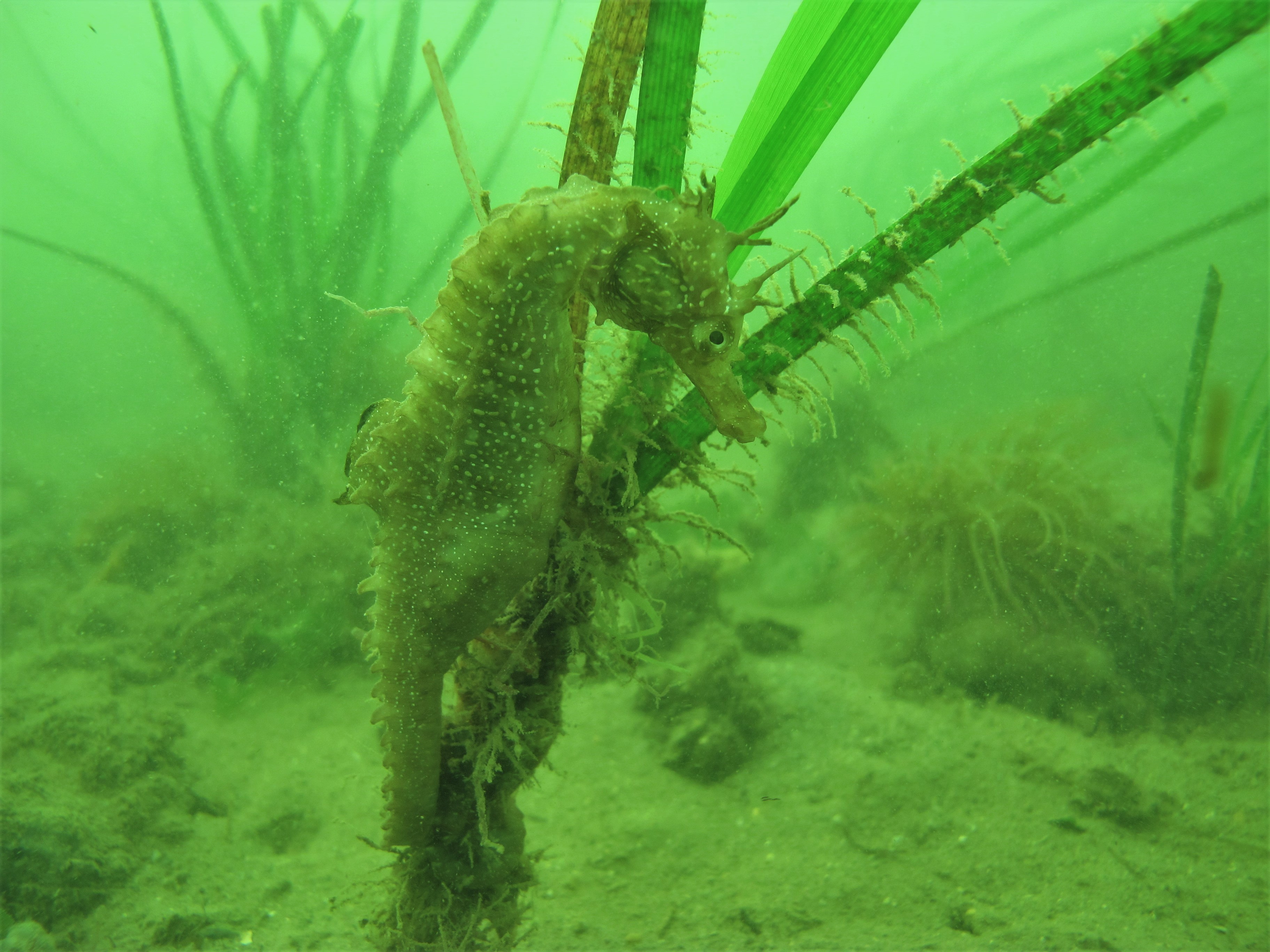
The seagrass areas are extensive banks of underwater seaweed, which display an important capacity to absorb the CO2, blue carbon credits, with a major potential to attaining the carbon neutrality by 2050. The seagrass areas of the Ria Formosa generate unique, complex and productive habitats which enhance the global health conditions, whether being human or innate animal species, like the two genders of autochthonous seahorses (Hippocampus Guttulatus and Hippocampus Hippocampus). These iconic creatures depend on seaweeds and on their respective complex structure for camouflage, protection and prey capture, while they keep firmly attached to the seaweed filaments, by using their prehensile little tails therefore avoiding to be dragged away by strong currents. The Hipposave project also comprises actions towards environmental requalification in designated areas and included in the two protected marine areas recently created within the scope of the project and integrated in the protection and conservation plan for these species.
The Ria Formosa saltpans “Salinas”, like the ones that can be observed from this panel, that may also host a number of seaweeds which hold a protection status (Genera Ruppia) and the maintenance and recovery of these long-abandoned infrastructures will also add to the prosperity of the seahorse and of the Ria Formosa ecosystem.
The seaweed areas of the Ria Formosa have been vanishing due to illegal captures of bivalves with unlawful fishing methods (dragging devices), fishing boats and touristic activities boats, and the associated anchors, dredging activities, blooms of seasonal algae (Ulvas) and competitive invading algae (Caulerpa).